

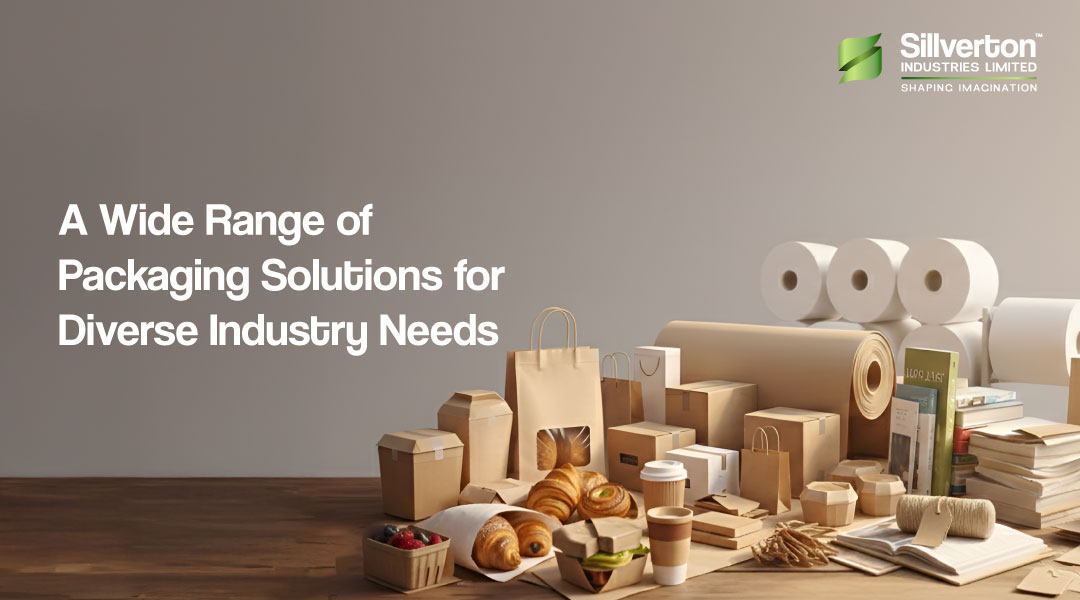
Packaging requirements are rarely universal. Packaging optimised for FMCG applications frequently falls short in pharmaceutical settings, just as food retail formats may not meet the rigour of industrial logistics. As industries become more regulated, supply chains become more complex, and sustainability expectations become more defined, packaging has evolved from a standardised input into a highly application-specific solution.
Sillverton Industries addresses this complexity through an integrated manufacturing portfolio that spans food-grade papers, pharmaceutical base papers, corrugation and liner grades, writing and printing papers, and specialty packaging substrates. With over three decades of operating experience and a manufacturing capacity of 3,70,000 MTPA, Sillverton designs paper grades with application-specific properties such as controlled porosity, strength optimisation, print compatibility, and food-contact safety, enabling consistent performance across multiple industries.
Today, businesses increasingly look for packaging partners who can support diverse requirements across sectors, offering a wide range of packaging solutions that balance performance, compliance, and efficiency.
Industry-Specific Challenges Demand Tailored Packaging Solutions
Every industry places a different kind of stress on packaging. Food packaging must prioritise hygiene and safe contact. Pharmaceutical packaging demands precision, sterility, and regulatory compliance. FMCG packaging balances speed, shelf appeal, and cost efficiency. Educational and publishing materials require durability, print consistency, and long-term usability.
Generic packaging formats struggle to meet these varied demands. A one-size-fits-all approach often results in overengineering in some cases and underperformance in others. Tailored packaging solutions allow materials to be engineered around real-world use, how the product is handled, stored, transported, and consumed—rather than relying on assumptions.
This industry-specific approach reduces waste, improves performance, and ensures that packaging works as an asset rather than a limitation.
From Single-Product Vendors to Multi-Portfolio Packaging Partners
Packaging procurement has also changed. Earlier, businesses worked with multiple suppliers for different needs, one for cartons, another for liners, another for food wraps. While this worked at a small scale, it often introduced inconsistency, longer lead times, and quality variations.
Today, many brands prefer consolidated packaging partners offering a wide range of packaging solutions across categories. Multi-portfolio suppliers bring better material alignment, consistent quality standards, and smoother coordination across product lines.
For businesses, this consolidation simplifies procurement, improves traceability, and allows packaging to evolve in sync with changing product portfolios rather than in silos.
Secondary Packaging: The Quiet Backbone of Product Safety
Secondary packaging rarely receives the attention it deserves, yet it plays a critical role in supply-chain reliability. Corrugated box papers, liner boards, and industrial wrapping papers protect products through long-distance transit, stacking, and repeated handling.
Failures in secondary packaging often show up as transit damage, product returns, or pallet instability—issues that directly affect cost and customer confidence. Well-engineered corrugation papers and industrial wraps provide the necessary compression strength, tear resistance, and dimensional stability to withstand logistics stress.
In many industries, secondary packaging is not just protection; it is insurance against avoidable losses.
Food-Grade Compliance Across Packaging Formats
Whether it involves grocery bags, fast-food wraps, baking papers, or takeaway containers, all materials are required to comply with regulated food-contact safety norms while delivering consistent performance in everyday use.
Maintaining food-grade compliance across a wide range of packaging solutions requires controlled manufacturing environments, consistent raw-material sourcing, and rigorous quality testing. Odour neutrality, grease resistance, and hygiene are not optional features; they are fundamental requirements.
As food consumption patterns evolve and regulations tighten, food brands increasingly rely on packaging partners who can maintain food safety standards consistently across product lines, not just in isolated formats.
Pharmaceutical Packaging Leaves No Margin for Error
Pharmaceutical and medical packaging operates under non-negotiable standards. Even minor deviations can compromise product integrity or regulatory approval.
Packaging used in healthcare applications must offer clarity for printed information, precision in folding and sealing, and compatibility with sterilisation processes. Papers used for blister packs, inserts, outserts, and medical wraps require tight GSM control, lint-free surfaces, and predictable performance.
In this sector, packaging is as much about trust as it is about protection. Consistency, traceability, and compliance define success.
Flexible Packaging That Balances Speed and Performance
FMCG brands operate at high volumes and high speeds. Packaging must run efficiently on automated lines while supporting branding, barrier requirements, and shelf appeal.
Flexible packaging solutions—such as lamination-ready base papers, sachet materials, and label stocks—allow brands to adapt quickly to changing product formats and consumer preferences. These materials must offer surface uniformity, print compatibility, and structural reliability to perform at scale.
Flexibility in packaging is no longer just about material choice; it is about enabling faster innovation without compromising efficiency.
Liquid Packaging Innovation Beyond Basic Cupstock
Liquid packaging presents a unique technical challenge. Since liquid packaging is exposed to moisture, heat, pressure, and sealing conditions, it requires materials designed to perform reliably in direct contact with liquids.
Modern liquid packaging solutions go beyond basic cupstock. They involve controlled, compatibility with PE coatings or alternative barrier layers, and structural stiffness that holds shape during use. Beverage cups, cartons, and straw papers all require different performance characteristics depending on temperature, usage duration, and disposal expectations.
Innovation in liquid packaging focuses on balancing performance with sustainability, reducing reliance on plastic while ensuring reliability.
Customisation as a Strategic Advantage
Customisation has become one of the strongest differentiators in packaging. Bespoke GSM ranges, surface finishes, strength parameters, and functional treatments allow businesses to optimise packaging for their exact requirements.
Rather than overusing material “just to be safe,” customised packaging enables right-sizing, improving performance while reducing waste and cost. This approach supports both sustainability goals and operational efficiency.
For growing brands, customisation also allows packaging to evolve alongside product innovation rather than acting as a constraint.
Bringing It All Together: Packaging That Works Across Industries
A wide range of packaging solutions is no longer a luxury; it is a necessity for businesses operating across multiple categories and markets. What matters is not just variety, but the ability to engineer packaging that performs consistently across industries, applications, and supply chains.
This is where experienced packaging solution companies differentiate themselves by combining material science, manufacturing discipline, and application knowledge to deliver packaging that works in real conditions.
At Sillverton Industries, this philosophy drives everything from paper manufacturing to application-specific development. With decades of experience and a diversified portfolio spanning food-grade, pharmaceutical, FMCG, industrial, and liquid packaging applications, Sillverton supports brands with packaging solutions designed for performance, compliance, and scalability.
By offering a wide range of packaging solutions under one roof, Sillverton enables businesses to simplify sourcing, maintain quality consistency, and adapt packaging strategies as industry demands continue to evolve.
For businesses seeking consistent quality across food-grade, pharmaceutical, and secondary packaging applications, connect with Sillverton Industries at www.sillvertonindustries.com to explore scalable, industry-ready packaging solutions.


